My First Year as a Teacher: One Email, Six Groups, 316 Lessons
In May 2023, I started writing an email to Tallinn Polytechnic School asking whether they might need a part-time teacher.
No, I hadn't hit my head.
But yes, the decision was surprisingly spontaneous, like many good things in life.
I was sitting at my desk one morning before work and found myself thinking that after years of being a designer, photographer, entrepreneur and marketing specialist, I had accumulated experiences (learned my lessons) that might be useful to someone else.
Looking back, many of my work opportunities, the confidence behind them and the practical skills that made them possible can be traced back to Tallinn Polytechnic School. Now it was time to give something back.
I noticed that the school had opened a new specialty after I graduated: Visual Media. It immediately caught my attention because it was something I would have loved to study myself, had it existed back then. It covered pretty much everything I had ended up doing professionally since: video, photography, design, printing, online publishing and project management in the creative industry.
So I knew I wanted to teach Visual Media students.
A few minutes later, the email was sent.
The timing turned out to be almost suspiciously good. There happened to be a vacancy that matched what I was looking for almost perfectly. Had I decided to write later, I probably would not be putting together this article today.
Two Roles, One Feedback Loop
At the time, I was already working full-time in the private sector and running Walgus, the marketing agency I had co-founded with former Polytechnic School classmates.
Teaching was never intended to replace my professional work. Quite the opposite.
I still had my own school experience in mind and believed the classroom should stay connected to real projects, real clients and real business problems – the kind of lessons that are often learned only after making expensive mistakes.
Why Not Do It Full-Time If You Like It?
Whenever I've been offered a full-time teaching position, I've given the same answer: I think I can be a better teacher if I keep my “day job” alongside teaching. It gives me current examples and practical knowledge to bring into the classroom, while the change of pace helps keep me motivated.
As I've told my students: “How many Valentine's Day cards can we design?” Let's work on something real.
It turned out to work the other way around as well. Students and interns bring fresh perspectives, new ideas and different ways of approaching problems into my everyday work. Sometimes they notice possibilities I wouldn't have considered myself. Sometimes, explaining something to them makes me question whether everything I'm asking for is actually necessary.
So the two roles have ended up feeding each other.
Moreover, I was, in a way, helping to train my future colleagues in the creative media industry. With a bit of luck, they will also be paying my pension one day.
Erlich in the private sector, shortly before becoming a teacher.
Before the First Lesson
My first school year, 2023/24, actually began before the first lesson.
In August 2023, I took a holiday from my full-time job and joined the admissions committee for the Polytechnic School photography programme. It was my first opportunity to meet future students and see the school from a completely different perspective.
The moment felt somewhat symbolic. Many years earlier, I had walked through the same doors hoping to study photography. Life took me in a different direction and I eventually graduated from the Print Technology programme instead. Now I found myself sitting on the other side of the table.
As a student, the media teachers' room was where you ended up if you needed to discuss an unfinished assignment at the end of the school year or have some other serious conversation. Now I had my own desk here.
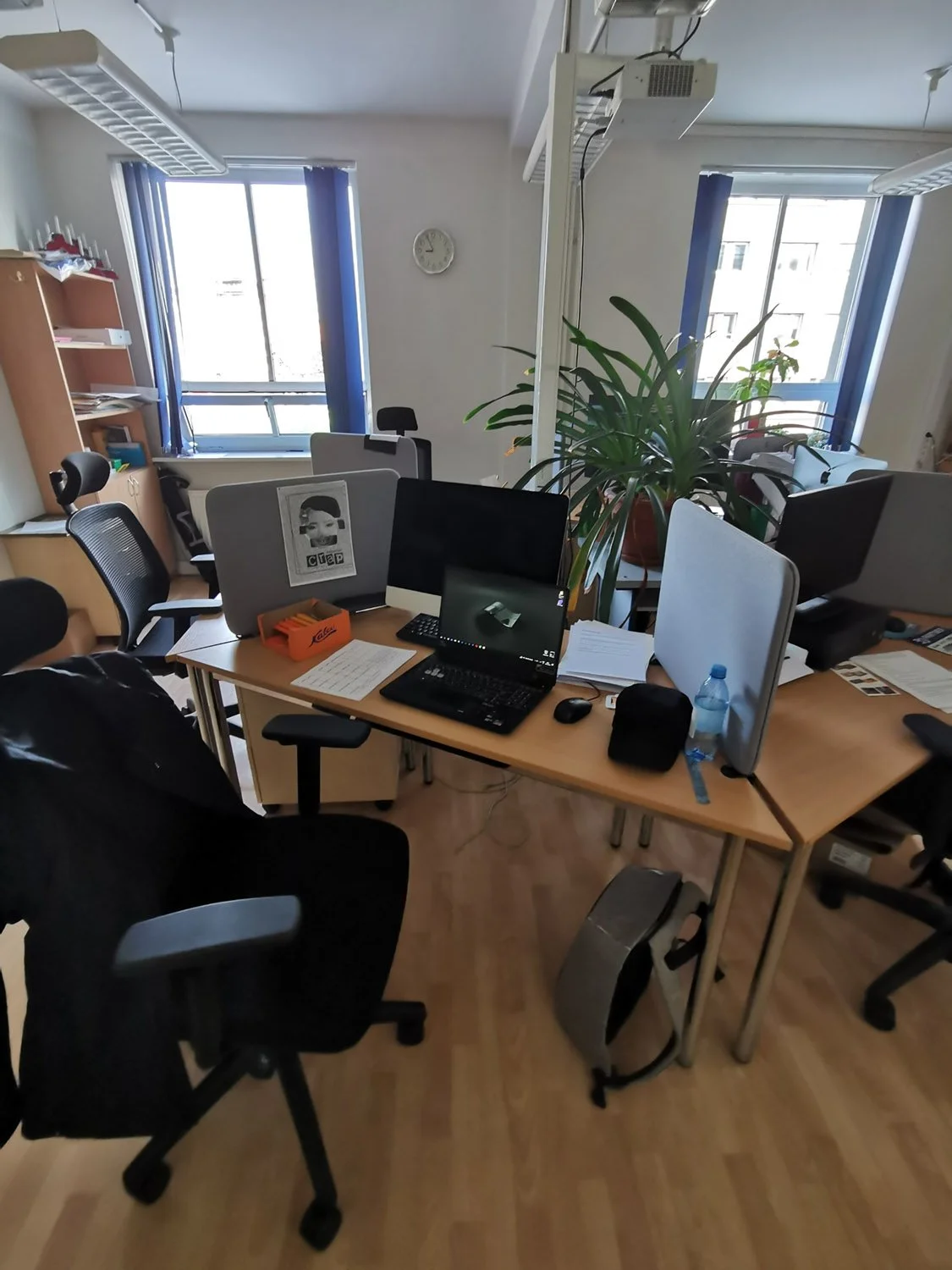

One small detail made me smile. More than five years after graduating, a Walgus sticker was still attached to the back of one of the teachers' Mac computers. We had started the company together with my schoolmates Reio and Erik while studying there, and apparently nobody had found a good reason to remove it.
Order of Battle
During my first semester, I taught five very different groups.
MM-23 (1st year multimedia students) – Graphic Design and Software
MM-22 (2nd year multimedia students) – Print Design and Layout
TT-22E (2nd year print media students) – Periodical Editions
VM-21 (3rd year visual media students) – Practical Project Management
KTO-23 (1st year TV operators) – Photography
The second semester also added another subject with a sixth group – Visual Identity for TT-23E (fifteen first-year print media students).
Plenty to keep me busy for a part-time job.
The Lessons Behind the Lessons
On paper, I was teaching software, photography, design and project management.
However, one thing became clear almost immediately: students rarely struggle because of a lack of information, as long as you keep providing it. More often, the real challenge for students is confidence, communication, collaboration, focus, discipline or simply believing that improvement is possible. The same is probably true for teachers as well.
Because of that, many lessons gradually became about larger ideas. Many of which I also wanted to understand better.
Graphic Design
What I wanted to avoid was teaching a version of graphic design that only existed inside the classroom. Most of my examples came from real clients, real projects and real mistakes I had already made myself.
Marketing flyers from Romania that I used to show students how design differs across countries – and how it's often surprisingly similar.
Whenever possible, I connected assignments with situations that designers actually encounter at work. I brought real printed samples from Walgus projects into the classroom. We discussed client communication, printing, budgets, revisions, deadlines and the fact that design is often less about artistic self-expression and more about solving somebody else's problem.
And doing it well.
“Well… This Is New”
This meme always amuses me because it captures something very real about teaching graphic design. Every major software update has the potential to change the lesson.
One moment from my first semester of teaching has stayed with me.
On the morning of 12 October 2023, Adobe released an Illustrator update that introduced text-to-vector generation. I hadn't even had time to try it myself.
When my print media students arrived, I told them:
"Starting today, you can generate vector graphics directly in Illustrator. Until this morning, that wasn't possible."
This was pivotal.
Photoshop had already introduced AI image generation a little earlier, but vector graphics somehow felt different. They had always been something you created manually, point by point, shape by shape.
Overnight, that assumption disappeared.
One of those mornings when you know the subject you're teaching has just changed. And I had only been teaching for a little over a month.
The lesson? Just because you were taught a certain way doesn’t make it valid now. Sometimes you have to learn the new tools yourself before you can explain them to anyone else.
Photography
The TV Operator group, around ten students, was probably one of my favourites. Perhaps because it was also a post-secondary programme, much like the Print Media course I had completed in the same school.
You could sense that many of the students already had a clearer idea of what they wanted to do and why they were there.
Teaching photography in B-201 classroom.
This was another full-circle moment. Years earlier, I had sat in the same classroom as one of Mr. Tirul's photography students.
In five weeks of Friday photography classes, we talked about cameras, light, studio equipment and composition, but also about observation, courage and learning to see ordinary things in less ordinary ways.
“Watch the foreground, watch the background and watch the edges of the frame.”
Project Management… or Classroom Management?
After becoming a teacher, I was surprised by how much conversation there is around classroom management. Teachers regularly share ideas, experiences and practical techniques, and there is no shortage of research on the subject either.
“I came here to teach, not to raise someone else's kids.”
It's a phrase I've heard more than once.
Project Management for the final-year Visual Media group was one of the more challenging courses.
There were 19 students in the first lesson. Okay, not bad – first-year groups could have up to 35 and barely fit in a classroom. Still, it had something of an American high school movie about it: a new teacher waiting in the classroom as a group of considerably more battle-hardened public school students walked in.
Some had already decided they disliked the subject before my class even began. By the third year, a few were mentally halfway out the door.

A useful introduction to project management theory.
Coming from the private sector, I initially thought real projects and practical stories might be enough to turn things around. But if the school had not managed to win someone over during the previous two years, one more subject was unlikely to magically change that. What I was there to teach them would only add to the irony.
We spent part of the semester dealing with that resistance.
…So What Actually Worked?
Listening.
Listening to the students, their ideas and what they actually cared about, and then looking for ways to connect those things with what I was supposed to teach.
A useful rule I've picked up is that when introducing, developing or selling a thought, spend at least 60% of the conversation listening and no more than 40% talking. You are there to teach, not to preach.
After covering project management theory, we focused on what creative work looks like in real life. We talked about services, pricing, invoices, clients, communication and all the things that rarely appear in textbooks but show up quickly once somebody starts working.
We discussed how to disagree respectfully, how to prevent misunderstandings and why “a project manager does not assume – a project manager verifies.”
This is not about you at all
One of the most useful things I learned during that first year had little to do with the subjects I was teaching.
It was learning not to take everything personally.
Some groups were easy to teach. Others were significantly more challenging. Students arrived with different backgrounds, motivations, strengths and difficulties. Sometimes there were conflicts or misunderstandings. Sometimes things simply did not go according to plan.
At first, those situations felt much more personal than they needed to.
Of course, it helps to do your job well and teach a subject you genuinely care about. I'm certainly not talking about giving students an assignment, expecting them not to bother you with questions and then blaming them when they fail. I've found that frustrating as a student myself.
But even when you are doing your best to help, difficult behaviour often has very little to do with the teacher standing in front of the classroom.
None of us arrives as a blank slate. We all bring something with us, and sooner or later it begins to show.
Instead of asking:
“Why is this student making my job difficult?”
I found myself asking:
“What is happening here that I don't yet understand?”
That small change made the work both clearer and more meaningful.
Why I Teach
People occasionally ask why I chose teaching when I already had a career outside education.
I sometimes joke that the salary in teaching is low enough that it forces you to be honest about your motivations. If you keep doing it, there is probably another reason.
There's also that old joke: “Those who can, do; those who can't, teach.”
Fortunately, nobody said you have to choose. I decided to keep doing both, just to be safe.
For me, it came down to three main reasons:
I enjoyed helping and seeing others make progress,
I wanted to share some of the lessons and mistakes I had collected along the way,
I felt like giving something back to the school that had helped start my own career.
And there was a fourth benefit running through all three: teaching gave me another reason to keep myself sharp and up to date with changes in the industry.
1. Helping Others Learn
Throughout my career, I had often become the person responsible for helping new colleagues learn the job.
“What would I have told myself when I just started out and might’ve had to learn the hard way? Can I present it in a way that makes it intriguing or meaningful?”
At one of my first professional jobs, when my manager heard I was leaving, he kept paying me to come back after hours and train my replacement. Apparently, being able to explain the job was useful enough to keep me around a little longer.
At some point I realised that I genuinely enjoyed that role.
There is something satisfying about passing on knowledge that took years to acquire and giving practical, verified answers to questions I once had to figure out through trial and error.
2. What I Wish I’d Known
I also wanted students to avoid at least some of the mistakes I had already made – so they could make other mistakes, not the same old boring ones. How many generations of design students need to accidentally export a PNG with a transparent background?
In a way, teaching allows experience to travel faster than time.
3. Reaching Full Circle
Years later, I was teaching in some of the same classrooms where I had once been a student, now bringing my own professional experience back with me.
Teaching also turned out to be a good way of staying a student and to keep learning myself. Teachers train a lot, and the job introduced me to subjects I probably would not have explored otherwise.
I took this photo during a mindfulness course I attended in my first year as a teacher. Tools for staying mindful, laid out on the floor.
What the Students Taught Me
My first year as a teacher probably taught me at least as much as I taught my students.
It improved my communication skills, patience and ability to work with very different types of people. It forced me to explain ideas more clearly and think harder about what actually matters.
Sometimes you think you understand something until you have to explain it to a room full of people who don't.
Most importantly, teaching didn't feel separate from the rest of my work. It felt surprisingly familiar.
In many ways, I had already been teaching for years — just under different job titles.
Photography, design, marketing, entrepreneurship, project management and teaching all eventually come back to the same thing:
People.
One nice memory from the end of my first school year is from May 2024, when the multimedia students hosted a workshop for primary school graduates interested in joining the school. They had spent the year working in Illustrator and now had to teach someone else how to use it, helping the visitors design their own posters.
Multimedia students teaching Illustrator during the school’s open day, May 2024.
It was cool to stand back and watch them explain to others the same things we had been learning together throughout the year. The first school year was coming to an end, and in a small way the students had become the teachers.
ENDEX! The End of Year One
By the end of the school year, I had taught 316 academic hours and memorised the names of 107 students.
I had kept up a full-time job while teaching part-time, and somehow survived.
In February 2024, my professional life took another unexpected turn. I joined Tallinn Folk High School as a full-time marketing specialist, while continuing to teach at Polytechnic School.
When the new school year began that autumn, I returned with more confidence, better lesson plans and a much clearer idea of what kind of teacher I wanted to be.
To be continued…